
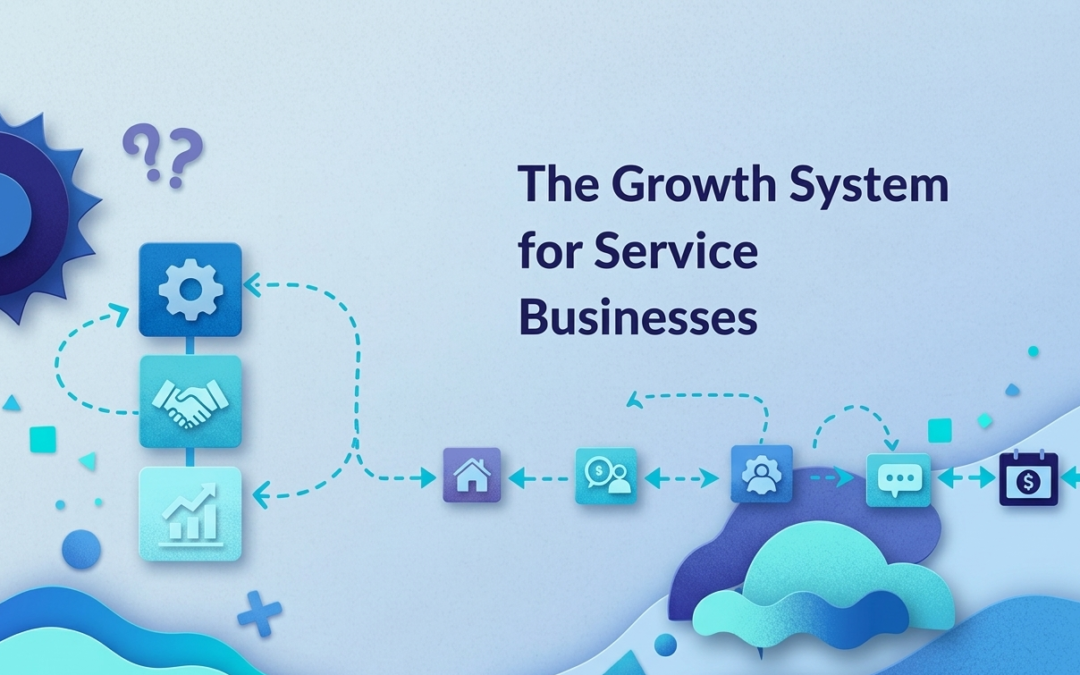
Why most service businesses don’t have a growth problem, they have a system problem
Service businesses rarely fail because people don’t need what they sell. They fail because growth is inconsistent. One week is slammed, the next week is light, and nobody can explain why. When that happens, owners assume they need more marketing, more spend, or more staff, but the real issue is usually simpler: the business does not have a reliable system that turns demand into booked appointments and customers.
A growth system is what makes results repeatable. It replaces “hero effort” with consistent execution, so your calendar doesn’t depend on the owner’s memory or whether the office was overwhelmed when the phone rang. When your system is weak, you feel chaos. When your system is strong, you feel control.
What a “growth system” actually is
A growth system is not a single tool, not a single campaign, and not a trendy tactic. It’s the full chain from attention to revenue, built to run the same way every day. It includes how prospects find you, how they convert, how they get booked, and how they get followed up with until they buy.
Most businesses have pieces of a system but not a connected system. They have a website, some ads, maybe a Customer Relationship Management (CRM), and a calendar tool. The gap is that those tools don’t behave like one integrated workflow, so leads slip through cracks and performance becomes unpredictable.
The only growth equation that matters in service businesses
In service businesses, growth is decided by a simple equation: how many inquiries you generate, how many you respond to quickly, how many you convert into booked appointments, and how many you close into customers. If any step is inconsistent, the entire business becomes unstable.
This is why chasing “more leads” often backfires. If response times are slow and follow-up is inconsistent, more leads simply increases your workload and your waste at the same time. A real growth system fixes conversion and follow-up so every marketing dollar produces more booked work.
Step one: build demand where people already have intent
Predictable growth starts with intent. The best channels for service businesses are the ones where customers are already looking for a solution, not the ones where you’re trying to convince strangers to care. Search, local visibility, and reputation-driven discovery typically outperform broad awareness for most service categories.
This doesn’t mean you can’t do social or content. It means those efforts should support intent-based discovery rather than replace it. When you anchor growth in intent, you reduce volatility and increase the quality of the leads you attract.
Step two: make your website a conversion engine, not a brochure
A service business website should do two jobs: establish trust quickly and move visitors into action. If it takes too long to understand what you do, why you’re credible, or how to book, you’ll lose people to the competitor who made it easier. Most businesses think they have a marketing issue when they actually have a conversion issue.
Conversion is about clarity and friction. Clear service positioning, visible proof, fast load time, and obvious next steps will beat fancy design almost every time. A growth system treats the website as a salesperson that works 24/7, not a digital flyer.
Step three: centralize lead capture so nothing gets lost
When leads are scattered, your business is guessing. Calls get missed, forms go to inboxes, chats go to notifications, and referrals get scribbled into notes. That’s not a pipeline. That’s a leak. Centralizing lead capture means every inquiry becomes a record you can track, assign, and move forward.
This is the moment chaos starts to shrink. Once everything lands in one place, you can see what’s happening. You can spot stalled opportunities. You can identify which channels produce the best customers. You can stop relying on “tribal knowledge” and start running a real process.
Step four: speed-to-lead that’s consistent, not aspirational
Most service businesses lose deals because they respond when they can, not when the customer expects. Customers don’t wait hours for a call back. They move on. Fast response wins, especially in field service and other urgent categories, but it matters everywhere because responsiveness signals professionalism and competence.
A growth system responds immediately to every inquiry. Even if a human can’t jump in instantly, the system can confirm the request, set expectations, and guide the next step. This protects your lead investment and increases the chance the prospect stays with you long enough to book.
Step five: follow-up that doesn’t depend on memory
Follow-up is where most businesses quietly lose a fortune. Not because they don’t care, but because follow-up collapses during busy periods, which is exactly when the leads are coming in. If your process relies on someone remembering to call or text, you’re not running a system. You’re running on hope.
A growth system uses automation to ensure consistent follow-up until the prospect books or opts out. That means confirmations, reminders, and short sequences that keep the prospect engaged without sounding spammy. When this is done right, your conversion rate rises without increasing your marketing spend.
Step six: appointment booking that removes friction
Booking is not admin work. Booking is conversion. It’s the moment a prospect commits time, which is the strongest indicator of buying intent before money changes hands. If booking requires back-and-forth, unanswered calls, or waiting for someone to reply, you’re killing momentum.
A growth system makes booking easy and immediate, then protects the calendar with confirmations and reminders. When booking is streamlined, you fill more of your schedule with the same lead volume. This is one of the most direct paths to “more bookings” without “more chaos.”
Step seven: inbound call answering that doesn’t let high-intent calls slip away
Inbound calls are often your highest-quality leads because the customer is actively asking for help. The problem is that service businesses miss calls during peak hours, after hours, and in the middle of jobs or meetings. When that happens, the customer often calls someone else and you never get another chance.
A modern growth system uses AI conversational voice inbound call answering as a safety net and a conversion tool. It can answer, gather key details, and book an appointment or route to a human when needed. The goal isn’t to replace people. The goal is to stop losing revenue because humans can’t answer every time.
Step eight: pipeline visibility that turns growth into something you can manage
If you can’t see what’s happening, you can’t manage it. A growth system gives you a pipeline that reflects real stages, not theoretical stages. It lets you see how many leads are new, how many have been contacted, how many are booked, and how many are stuck waiting for a quote or decision.
Visibility creates calm because it removes uncertainty. It also creates improvement because you can identify bottlenecks and fix them systematically instead of guessing. This is what makes growth sustainable instead of stressful.
Why “marketing automation” matters more than most people think
Marketing automation in service businesses isn’t about newsletters. It’s about operational consistency. It’s about making sure every lead receives an immediate response, every appointment receives reminders, every no-show receives a reschedule path, every quote receives follow-up, and every happy customer is asked for a review.
When automation is tied to real behavior, it doesn’t feel robotic. It feels professional. It makes your business look bigger, faster, and more organized than competitors that rely on manual follow-up and good intentions.
What a real system changes for a 5–25 person business
At small scale, the owner can patch holes. At 5–25 people, patching becomes a full-time job and the business starts to feel fragile. A growth system makes performance less dependent on specific individuals and more dependent on the workflow. That’s what allows you to hire, delegate, and expand without everything breaking.
This is also where “less chaos” becomes measurable. You see fewer missed opportunities, higher booking rates, fewer no-shows, and better reporting. You stop asking, “Why are we slow this week?” because you can see exactly what happened and what to fix.
How this applies across different service industries
The details change by industry, but the system stays the same. Field service needs speed, local trust, and fast booking. Financial services needs credibility, nurturing, and careful compliance. Healthcare and wellness needs reputation, convenience, and schedule protection. Professional services needs authority, qualification, and consult booking. Technology needs pipeline hygiene, routing, and consistent follow-up across longer sales cycles.
A growth system adapts the messaging and rules to fit the industry, but it keeps the structure consistent so performance is repeatable and measurable.
What “less chaos” actually looks like day-to-day
Less chaos looks like calls being answered even when you’re busy, forms being followed up with automatically, and leads being owned instead of floating around. It looks like the calendar being full because the booking process is clean and the reminder system reduces no-shows. It looks like leadership having visibility into the pipeline without micromanaging.
It also looks like better decision-making. When the system produces clean data, you can finally invest with confidence, cut what doesn’t work, and scale what does.
Question & Answers
Q: What’s the first step to building a growth system if we’re already overwhelmed?
A: Centralize lead capture and enforce speed-to-lead. If inquiries are scattered and response times are slow, everything downstream becomes harder. Fixing those two stabilizes the business quickly.
Q: Do we need a new Customer Relationship Management (CRM) to build a growth system?
A: Not always, but you do need a platform that supports consistent lead capture, ownership, automation, booking, and reporting. If your current setup can’t do those reliably, you’re fighting uphill.
Q: How do we keep automation from feeling spammy?
A: Tie messages to real actions the prospect took, keep them short, and make the next step simple. Stop the sequence the moment they engage or book. Helpful and relevant beats frequent and generic.
Q: How does AI inbound call answering fit without frustrating customers?
A: It works best when it’s designed to be fast, conversational, and focused on intake and booking, with clear escalation to a human when needed. The goal is always to reduce friction and protect high-intent calls.
Q: What metrics prove the growth system is working?
A: Response time, lead-to-booked rate, show rate, booked-to-close rate, missed call recovery, and cost per booked appointment. Those metrics tell you if your system is converting demand into real revenue.